5 Main Types of Fuel Pumps & How They Work?
What is a Fuel Pump?
Mechanical, electric, and high-pressure fuel pumps are the three types. A fuel pump is a fluid-handling device that moves gasoline from the fuel tank to the engine. It’s often found in internal combustion engines. The fuel pump in spark-ignition engines transports gasoline from the tank to the fuel bowl, where the carburetor mixes the fuel with air and transports it to the engine’s combustion chamber.
The fuel pump delivers high-pressure fuel straight to the combustion chamber in combustion ignition engines. In combustion ignition engines, the combustion enclosure is already filled with highly compressed air at the moment of combustion. As a result, the fuel pump must deliver fuel to the combustion chamber at a pressure more significant than the combustion chamber, and ignition occurs.
Construction and Working of a Fuel Pump
The plunger is driven by a bottom-mounted cam and tappet mechanism. The plunger reciprocates in the barrel. The number of cylinders in the engine equals the number of plungers in the engine. The plunger has a rectangular vertical groove that spans its length of it.
The delivery valve is lifted off its seat by the pressure of the gasoline on the spring. The fuel is supplied to the injector through the delivery valve. When the plunger hits the bottom of its stroke, the supply port and spill are exposed, and fuel from a low-pressure pump is pushed into the barrel after filtering.
Types of Fuel Pumps
There are three primary types of gasoline pumps on the market, each of which is described below:
- Mechanical Fuel Pump
- Electrical Fuel Pump
- Fuel Pump with Diaphragm
- Diaphragm Fuel Pump
- Fuel Pump with a Plunger
These are primarily low-pressure fuel pumps, however, they are occasionally employed for high-pressure applications whose primary function is to move gasoline from the tank to the spark-ignition engine’s fuel bowl. There are two types of mechanical fuel pumps: diaphragm-type fuel pumps and plunger-type fuel pumps.
1. Mechanical Fuel Pump
These are primarily low-pressure fuel pumps, however, they are occasionally employed for high-pressure applications whose primary function is to move gasoline from the tank to the spark-ignition engine’s fuel bowl. There are two types of mechanical fuel pumps: diaphragm-type fuel pumps and plunger-type fuel pumps.
2. Fuel Pump with Diaphragm
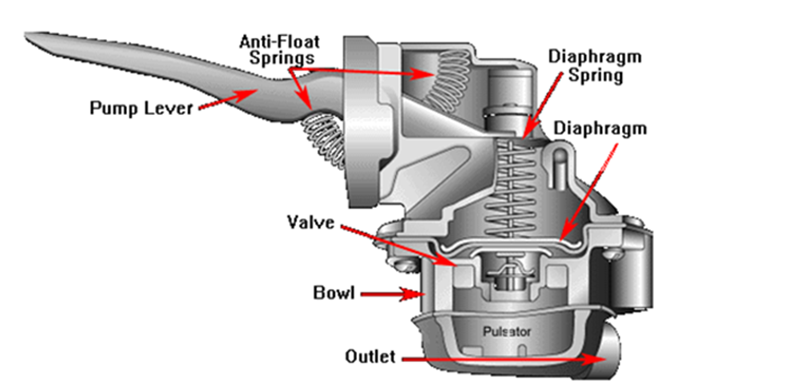
The diaphragm-type fuel pump is a positive displacement pump that suctions fuel by expanding and compressing the diaphragm. The intake and exit check valves, which are one-way valves, make up the pump body. The pressure within the pump falls below atmospheric pressure as the diaphragm compresses, and the gasoline is sucked through the inlet valve. The fuel within the pump was forced out through the output valve when the diaphragm expanded. A lever activated by an eccentric cam motion controls the diaphragm’s expansion and contraction motion. Through a suitable gearing arrangement, this eccentric cam is coupled to the engine’s crankshaft.
3. Fuel Pump with a Plunger
The plunger-type fuel pump is likewise a positive displacement pump that uses the reciprocating action of the plunger to suck and distribute fuel. The plunger is contained within a cylinder, and one side of the plunger is linked to the camshaft via a push rod. The valves are attached to the cylinder’s end. Fuel is pulled into the cylinder as the plunger goes backward, and fuel is delivered out of the cylinder as the plunger moves forward.
Although the pressure of the gasoline provided by the mechanical pumps is constant, the large number of moving components necessitates adequate maintenance. These pumps are no longer in use because automobiles have switched from carburetors to fuel injection systems.
4. Fuel Pump (Electric)
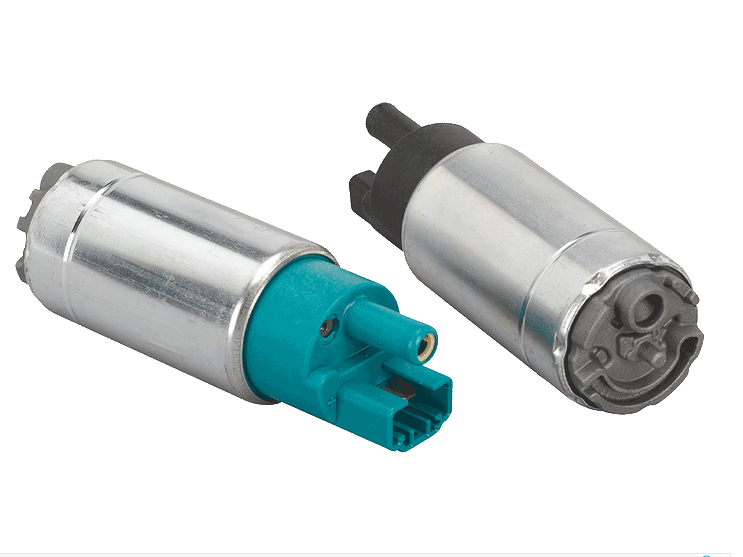
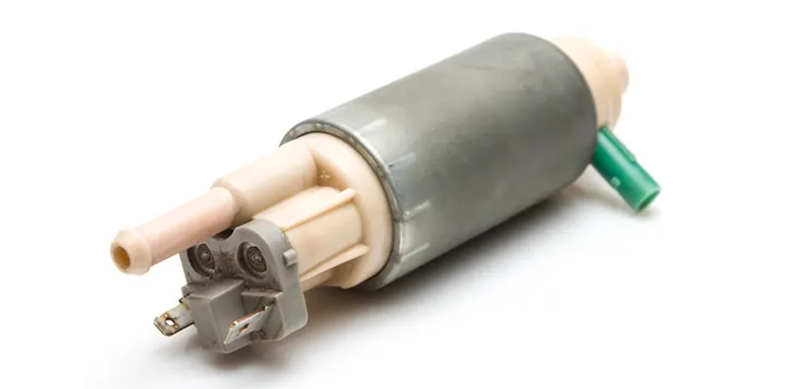
These pumps are commonly found in fuel injection systems, which are an integral feature of contemporary automobiles. It generates high pressure to distribute gasoline from the pump. This tremendous pressure might cause the gas within the pump to ignite, resulting in an explosion. As a result, the electric fuel pump should be maintained away from the engine and, more particularly, within the gasoline tank, for safety reasons.
The vehicle’s battery provides the current required to run the fuel pump. There is also an electronic control unit (ECU) that regulates the output pressure and volume of the gasoline, as well as meters the incoming fuel from the tank. The ECU assists the car in conserving fuel, resulting in improved economy and power. The diagram depicts the setup of an electric fuel pump.
5. Fuel Pump with High Pressure
These pumps are often employed in combustion ignition engines for the direct injection of fuel into the combustion chamber. Pumps of this sort operate at pressures of more than 200 Pascals. These pump systems are particularly complicated and durable to manage such high pressure. The basic high-pressure pump system, which includes flow rails, metering units, and distribution units, aids the pump in delivering fuel to the combustion chamber without wasting or over-fueling it.